Where to stay in London, by the evening you want to walk out into
There is no centre of London, which is why "central" is a phrase used mostly by people selling rooms. Eight districts, what each is for, and the one question to ask at booking.

Thirty towns that grew into each other, and no centre at all.Photograph Benjamin Davies · Unsplash
London is not a city with a centre. It is around thirty towns that grew into each other, and the practical consequence is that "central London" is a phrase used almost exclusively by people selling hotel rooms. A room in Paddington and a room in Shoreditch are both central and they are forty minutes and two entirely different holidays apart.
Choosing the neighbourhood matters more here than in any other European capital. Eight districts, what each one is actually for, and roughly what it costs you.
If you are here for one thing
Most people booking London have a fixed point: a shop, a station, a museum, a theatre. This is the shortest route from that to a neighbourhood.
- Selfridges and Oxford Street: Marylebone immediately north of it, Mayfair immediately south. Bond Street and Marble Arch are the stations. Marylebone is the more pleasant place to sleep and about ten minutes on foot from the front doors.
- The West End theatres: Covent Garden or Soho, and nothing else is worth the taxi at eleven.
- The V and A, the Natural History Museum and the Science Museum: South Kensington, which puts all three within a five minute walk.
- Harrods and Hyde Park: Knightsbridge, or Bayswater on the far side for half the rate.
- Heathrow: Paddington, fifteen minutes on the Express.
- The Eurostar: King's Cross and St Pancras, where you can walk to the platform.
- Portobello Road: Notting Hill, and go on a Friday rather than a Saturday.
- The Tower and Tower Bridge: Bankside or the City fringe.
- The City, for work: Shoreditch, which is where anybody working in the City would rather eat.
Covent Garden and Soho

The obvious answer for a first visit, and it mostly holds up. You are walking distance from the West End theatres, the National Gallery, the river and most of what people come for. The eating in Soho is genuinely excellent and runs late by London standards.
The trade is noise and price. Soho does not go quiet until well after one, and a street-facing room on a Friday is a bad idea in any hotel at any rate. Ask for a courtyard or a high floor and mean it.
Stay here if: it is your first trip, you have theatre tickets, and you intend to be out late anyway.
Bloomsbury and Fitzrovia
Ten minutes north and considerably calmer, with garden squares, the British Museum and a long tradition of hotels that are better value than their postcode implies. Fitzrovia in particular has become one of the best places to eat in London without anyone announcing it.
Stay here if: you want to walk into the West End but sleep somewhere residential. This is the single best compromise in London and it is chronically under-booked.
South Bank and Bankside
The river, Tate Modern, Borough Market and the walk from Westminster to Tower Bridge, which is the best hour of most people's first trip. Hotels here are frequently newer, larger and cheaper than the equivalent north of the river.
It is quiet at night, which is either restful or dull depending on your age and intentions. Our Tower Bridge review is at this end of it.
Stay here if: you want river views, museums and a lower rate than the West End.
Shoreditch and Hoxton

East, and the most changed part of London in twenty years. The design hotels are here, the bars are the best in the city, and Spitalfields and Brick Lane are ten minutes on foot. You are also twenty five minutes from Westminster, which matters if the trip is monument-shaped.
Stay here if: you have been to London before, you are here for eating and drinking, and you do not need to see the Abbey.
Notting Hill and Bayswater

Pastel houses, Portobello Road on a Saturday, and the calmest streets on this list. Bayswater beside it has the concentration of mid-range hotels and is markedly cheaper for the same walk to Hyde Park.
The catch is distance. You are thirty to forty minutes from the East End and twenty from the West End, and after three days that adds up to a lot of the Central line.
Stay here if: you want quiet, parks and a Saturday market, and are not trying to see everything.
Mayfair and St James's
The grand hotels, the expensive ones, and the best of London's old-fashioned service. Green Park and Hyde Park either side, Piccadilly and Bond Street between them. It is beautiful, extremely quiet in the evening, and there is almost nowhere affordable to eat.
Stay here if: the hotel is the point of the trip.
Knightsbridge and South Kensington
The museum quarter, and the part of London most visitors mean when they say they want somewhere grand and quiet. South Kensington puts the V and A, the Natural History Museum and the Science Museum within five minutes of each other, which makes it the obvious base with children in bad weather. Knightsbridge next door has Harrods, Hyde Park and the highest concentration of hotel swimming pools in the city.
It is expensive, and it is not where you would go for dinner: the eating is better in almost any other district on this list. But it is beautiful, genuinely quiet after eight, and the parks are on the doorstep.
Stay here if: the museums are the trip, or you want a pool and a spa without leaving the hotel.
King's Cross
Twenty years ago nobody would have suggested this. It is now one of the better neighbourhoods in London: Coal Drops Yard, Granary Square, the British Library, and the Eurostar and six mainline services under one roof. Rates are still below what the location deserves.
Stay here if: you are arriving by train, or combining London with Paris.
Paddington and Marylebone
Marylebone High Street is one of the most pleasant stretches in the city and the hotels around it are quietly excellent. It is also the best answer to a question a lot of people are really asking, which is where to stay near Selfridges: the store is at the Marble Arch end of Oxford Street, and Marylebone sits directly behind it without any of the noise. Ten minutes on foot, and you are eating somewhere worth eating rather than in a shopping street. It is also the better answer for couples than Oxford Street itself, which empties into a retail park after seven: Marylebone High Street keeps its restaurants and its pubs, and the streets behind it are residential and quiet by ten. Paddington next door is cheaper, blander, and fifteen minutes from Heathrow on the Express, which is worth real money on a short trip.
Stay here if: you are flying in and out of Heathrow on a two night trip.
Where the pools and spas actually are
Worth saying plainly, because it catches people out: a hotel swimming pool is rare in London in a way it is not in Madrid or Dubai. Most of the city's hotels are converted Georgian and Victorian buildings with no basement to put one in, so a pool is close to a luxury category of its own, and it is concentrated in three or four postcodes.
- Knightsbridge and Belgravia: the densest concentration. The Mandarin Oriental Hyde Park has a seventeen metre twin lane pool, and the Berkeley, Bulgari and Jumeirah Carlton Tower all have one.
- Mayfair and Park Lane: the Connaught, with its Aman spa, the Four Seasons at Park Lane, and the Dilly.
- Marylebone: the Landmark, beside Marylebone station, which is the nearest hotel pool to Selfridges and about twelve minutes on foot from it.
- Elsewhere, in ones: One Aldwych in Covent Garden, the Shangri La at the Shard on the South Bank, and the St Pancras Renaissance at King's Cross.
Spas follow the pools, more or less, and the same postcodes hold most of them. Below five star the word tends to mean a treatment room rather than anywhere to spend an afternoon, so it is worth asking what is actually in it before it decides the booking.
Gyms, or fitness centres if you are booking from America, are a different matter and almost universal above three star. The range runs from a proper room to a cupboard with a treadmill and a view of the bins, so if it matters, ask for a photograph rather than a description. Newer and larger hotels, which in practice means South Bank, King's Cross, Paddington and Canary Wharf, have far better fitness rooms than converted townhouses, where the building simply has nowhere to put one.
Arriving late, and one thing to ask
Not every London hotel has a reception desk staffed through the night, and this is the single most common unpleasant surprise on a late arrival. Chains and larger hotels almost always do. Townhouse conversions and small boutique places, which is most of the good stock in Bloomsbury, Marylebone and Notting Hill, frequently do not, and some hand out a door code instead of keeping anybody up.
If you land after eleven, or you are coming off a delayed Eurostar, say so at booking and ask the question directly: is reception staffed twenty four hours. King's Cross, Paddington and the South Bank have the newest and largest hotel stock and are the safest bets for a late check-in.
The other question worth asking is whether the rate includes breakfast, because in London it usually does not, and twenty five pounds a head is normal in anything calling itself luxury.
The rule in London is that you will spend more time getting places than you expect. Choose the neighbourhood you want to walk out into at eight in the evening, not the one nearest the sights.
The short answer
- First trip, three nights: Covent Garden or Bloomsbury.
- Best value for the location: Bloomsbury, King's Cross or South Bank.
- Second or third trip: Shoreditch.
- With children: South Bank, for the river and the space.
- Two nights from Heathrow: Paddington or Marylebone.
- The hotel is the holiday: Mayfair.
- A couple, wanting quiet: Marylebone, Notting Hill or South Kensington.
- You want a pool: Knightsbridge, or Marylebone if you also want Oxford Street.
- Shopping on Oxford Street: Marylebone, every time, rather than a room on the street itself.
- Landing late at night: King's Cross, Paddington or South Bank.
One practical note that applies everywhere: ask which floor and which side. London hotels are frequently converted terraces with a wide variance between rooms of the same grade, and the difference between the front and the back of the building is often the difference between sleeping and not. Once that is settled, what to actually do in London is the other half of it.
Read next

Things to do in London, ranked by whether they survive the queue
Thirty million visitors a year concentrated onto about eight attractions. What is worth it, what is worth it only under conditions, and what to do instead.
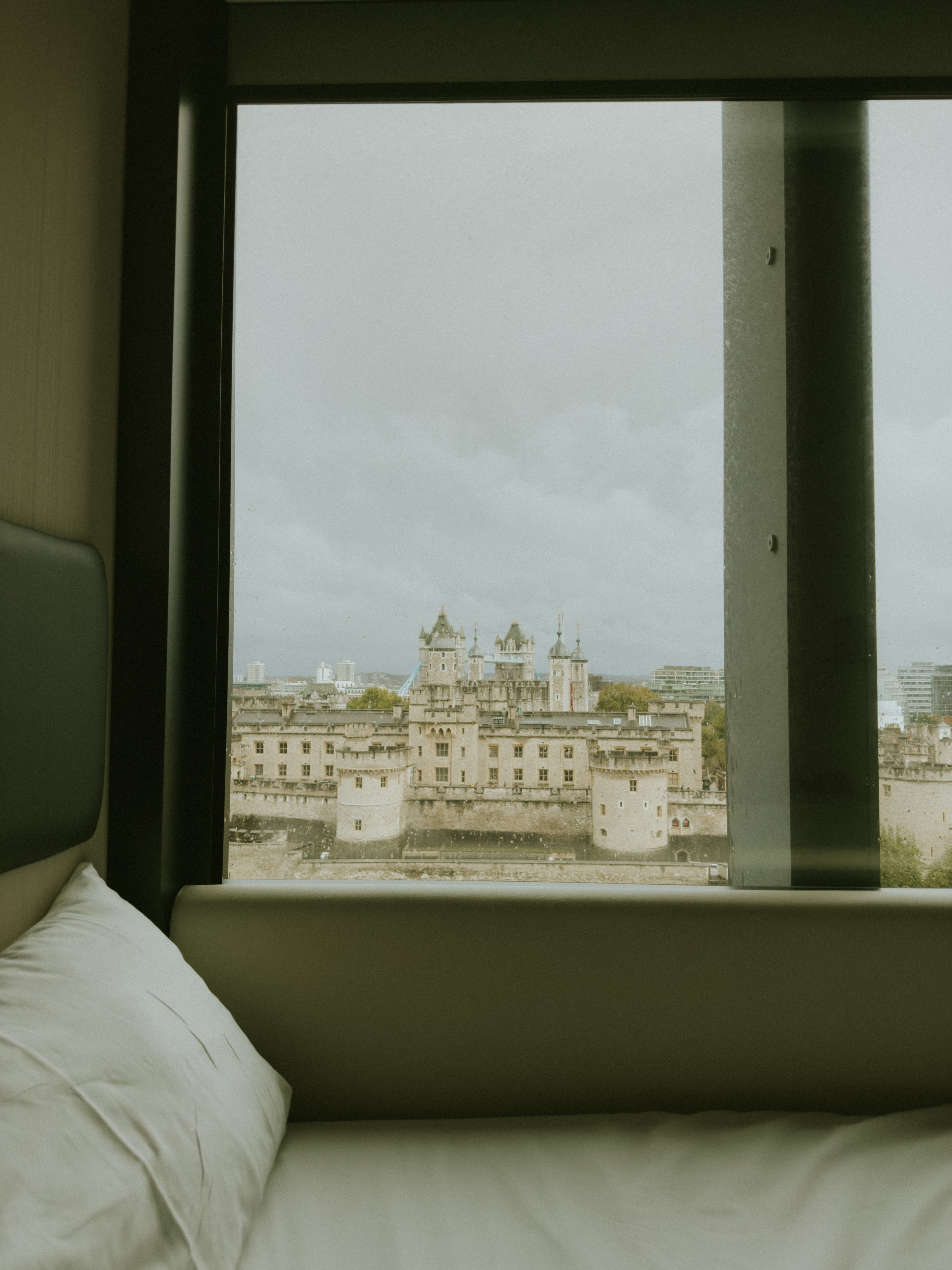
The London room where the bed wins and the second guest loses
citizenM Tower Bridge has designed brilliantly for one occupant, built a lobby worth working in and a rooftop worth staying up for. The room rate is the argument.

The paradores of Andalucia, and how to pick the ones worth the detour
Spain runs ninety-odd hotels in castles, monasteries and Renaissance palaces, at an average of about £112 a night. Five in Andalucia worth going out of your way for, including a UNESCO palace at €104 and a convent inside the Alhambra walls.