Sunday as a ritual, or how to check in without leaving the house
The feeling of being away is mostly a change of pace and attention. Which means it can be built at home, on a Sunday, by anyone willing to be deliberate about two days.

Photograph Quincy Alivio · Unsplash
The thing you remember about a good hotel is rarely the hotel. It is the morning you woke without an alarm and lay there for a while working out what the light was doing, and then the coffee, which someone else had thought about, and then the fact that nothing whatsoever was expected of you until lunch. Strip out the building, the view, the person who turned your bed down while you were at dinner, and what remains is a change of pace and a change of attention. Those two things are portable. They are, inconveniently for the travel industry, available on a Sunday in your own flat.
This is not an argument against going away. It is an argument that the sensation you are buying when you go away can be reverse-engineered, and that most weekends fail to deliver it not because they lack a destination but because nobody decided anything. Saturday absorbs the admin. Sunday absorbs the dread. The week arrives having already colonised the last six hours of the one before it. A designed Sunday is simply a Sunday where the decisions were made in advance, by you, on your own behalf.
The morning you do not schedule
Start with the alarm, or rather with its absence. Waking naturally is the single clearest signal the body has that it is off duty, and it is the first thing a hotel gives you by accident, because you have no reason to be anywhere. At home the alarm is usually set out of habit rather than need. Turn it off on Saturday night and the Sunday changes shape before it begins.
What follows matters more than people allow. Coffee made properly, with attention, taking the extra four minutes: not because instant is a moral failing but because the four minutes are the point. You are establishing, early, that this is a day with time in it. Anything done well and slowly at eight in the morning sets a tempo the rest of the day tends to follow.
Then breakfast, and here the distinction is between eating and having breakfast. Something cooked. Something that required a pan. Eaten sitting down, at a table if you have one, by a window if you have one of those. The window is not decoration. Looking outwards while you eat is what hotel breakfast rooms are engineered to produce, and it is the difference between fuelling and pausing. If your flat has one good window and it happens to be in the wrong room, move the chair. It takes a minute and it works.
The drawer
The phone goes in a drawer. Not on silent, not face down, not in another room where you will fetch it: in a drawer, for a defined stretch of the morning, with the stretch decided the night before so you are not negotiating with yourself at nine.
This is the hardest of the rituals and the one that does the most work. The reason a hotel morning feels wide is that nobody can reach you and nothing is accumulating in your eyeline. That condition is manufacturable. Two hours is enough to notice the difference; three is where the day genuinely opens out. The instinct to check is at its worst in the first twenty minutes and then subsides, which is useful to know in advance, because it means the discomfort is a phase rather than a verdict.
Luxury, when you look at it closely, is almost always someone having decided in advance that your time was worth protecting.
One long thing
Every good day away has a single anchor: one activity long enough to give the day a spine. Not three. One. The error most people make with a free Sunday is filling it with five pleasant hours that add up to nothing, when a day is made memorable by one thing that went on longer than it strictly needed to.
Three candidates, and the choice is largely a question of weather and mood. A long walk, meaning a proper one, two or three hours with a turnaround point rather than a loop of the local park. A long bath, run hot, taken in the middle of the day rather than at the end of it, which is a small perversity that makes it feel enormously indulgent. Or a long lunch, at the table, with wine, going on into the afternoon in the way lunches do on holiday and almost never do at home.
Whichever you pick, protect the length. The anchor only works if it is allowed to overrun. A bath cut short to get on with something else is just washing.
Turndown, performed by you
Hotels understand that the second half of a stay needs its own small ceremony, which is why someone comes in while you are out and makes the room feel newly arranged. You can do a version of this and it is more affecting than it sounds, largely because you are doing it for a later version of yourself.
Fresh sheets, changed on Sunday rather than whenever the laundry cycle dictates. Flowers, if there are flowers to be had, bought on the walk and put somewhere you will pass them repeatedly rather than somewhere they photograph well. Tidy the bedroom before the evening, not after. The effect of walking into a made room at nine at night, having not been the person who made it in any immediate sense, is disproportionate to the fifteen minutes it took.
The hour before the week
Sunday evening is where the whole thing is usually lost. The week starts arriving around six: the mental inventory, the half-hearted attempt to get ahead, the collapse into a screen that leaves you feeling neither rested nor prepared. It is the one part of the weekend that reliably belongs to Monday.
Two ways to take it back, and they are compatible. The first is to cook something that takes time: not something complicated, something slow, the kind of dish where the effort is spread thin across two hours and consists mostly of being in the kitchen. Standing over a pot is a form of attention that resists worrying about work, which is more than can be said for most alternatives.
The second is a proper cocktail hour, treated as an event with a start time rather than a drink poured while doing something else. One drink made carefully, at seven, sitting down, with the lights adjusted and something on the stereo. The formality is what distinguishes it from drinking. A hotel bar works on exactly this principle: it is not the gin, it is the fact that everyone in the room has agreed to stop for an hour.
What this actually costs
Almost nothing, which is the point and also the difficulty. Nothing here requires money. Everything here requires deciding, and deciding is harder than paying, because paying can be done once on a Tuesday afternoon and deciding has to be done again every week.
Quiet luxury has come to mean expensive things without logos on them. Its truer meaning is this: that the thing being purchased in any genuinely luxurious experience is attention, applied to time. A hotel sells you a version of that attention because you cannot easily generate it in a room you also pay bills in. But the mechanism is not proprietary. Two hours without a phone, one meal cooked properly, one activity allowed to run long, and clean sheets waiting at the end of it will produce a recognisable percentage of what you flew somewhere for.
Not all of it. There is no substitute for unfamiliar streets and someone else's idea of breakfast. But a good deal of what people mean when they say they need to get away is really that they need to be left alone at a slower speed, and that can be arranged on a Sunday, without a suitcase, starting with the alarm.
Read next

The paradores of Andalucia, and how to pick the ones worth the detour
Spain runs ninety-odd hotels in castles, monasteries and Renaissance palaces, at an average of about £112 a night. Five in Andalucia worth going out of your way for, including a UNESCO palace at €104 and a convent inside the Alhambra walls.

Are we tired of beige, or of rooms that could be anywhere
Colour is coming back to hotel interiors, and the trade press has decided this is a design story. It is closer to a complaint, made by guests, about rooms that could be anywhere.
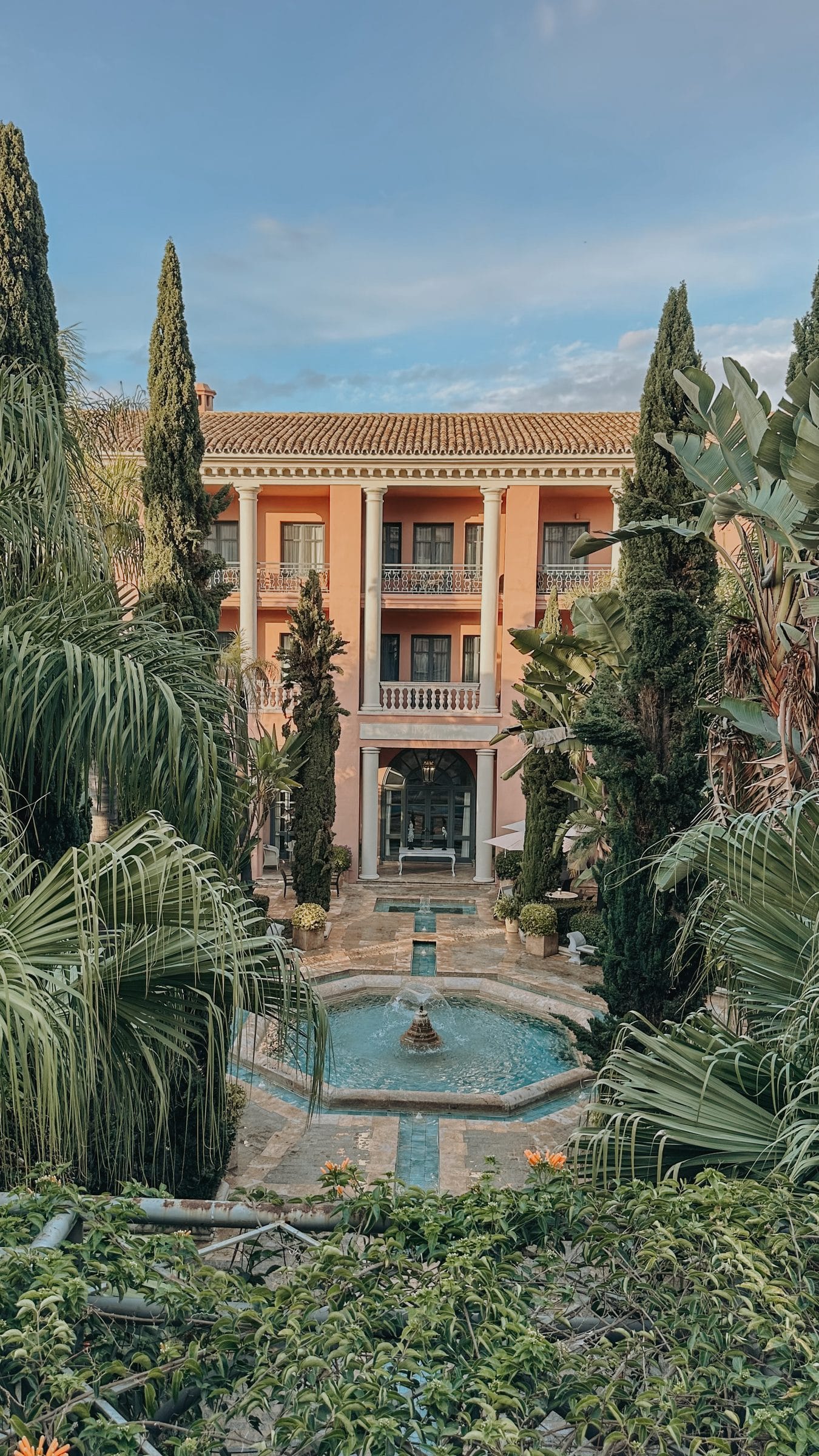
Anantara Villa Padierna: a Tuscan palace above Marbella, and the finest gardens on this coast
An Italianate palace ten minutes inland from Marbella, with formal gardens worth the trip on their own, a Roman pool, and staff who are the reason you would go back.