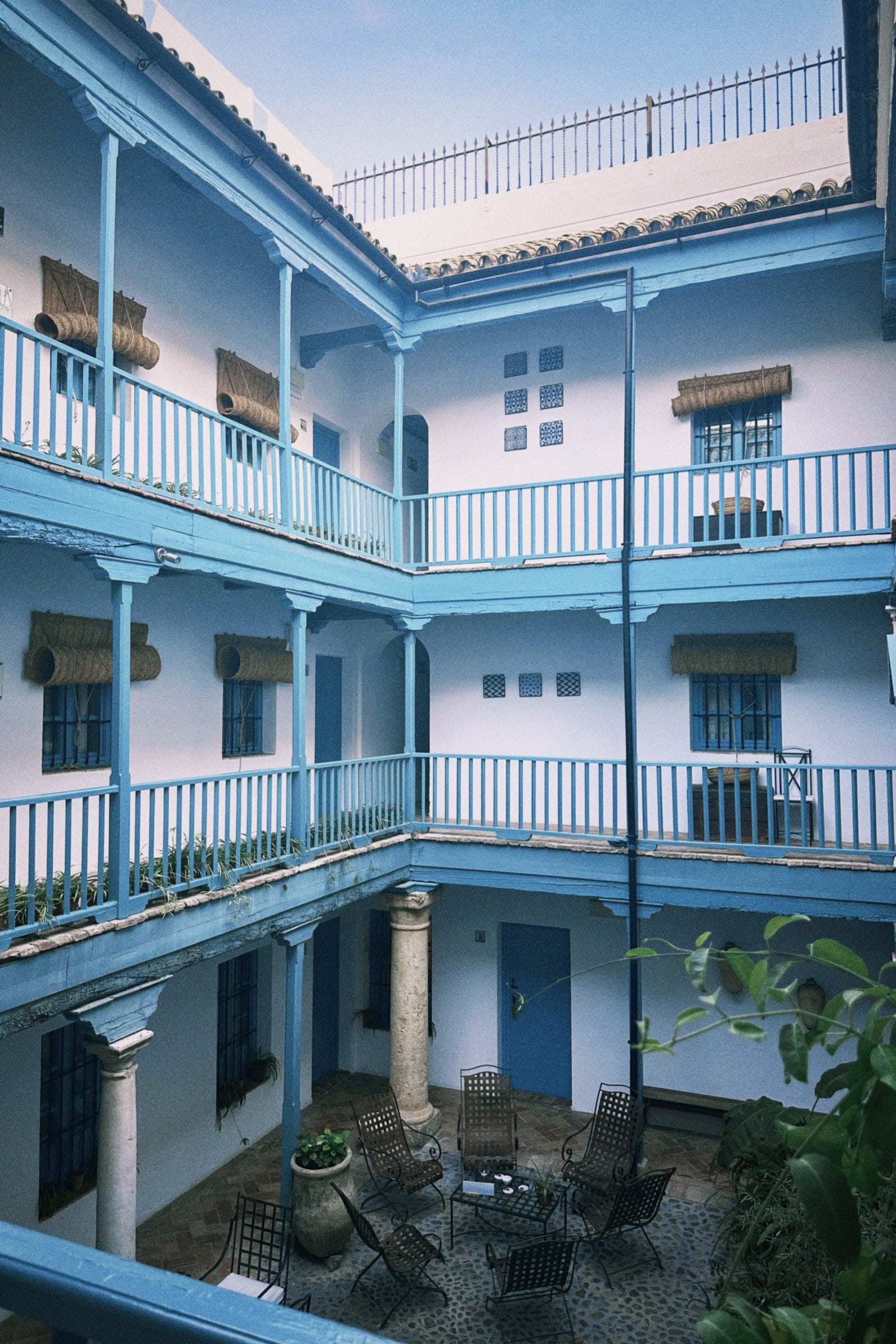
Whitewashed walls, blue timber, and a plan unchanged since it held a hundred families.Photograph by Adequately Luxurious
Hospes Las Casas del Rey de Baeza: a Seville courtyard house you will get lost finding
An eighteenth century corral de vecinos behind the Santa Catalina church, forty one rooms around cobbled courtyards, and a plunge pool on the roof that solves a Seville August.
A corral de vecinos was the ordinary housing of Seville: a communal courtyard with families living around it, sharing the well, the washing and everyone else's business. They were working buildings rather than beautiful ones, and most of them have gone. Las Casas del Rey de Baeza is an eighteenth century one on the edge of Santa Catalina, and from the street it still looks like what it was, whitewashed and shuttered and giving nothing away.
Inside it is forty one rooms arranged around cobbled courtyards, under the Hospes name and a member of Design Hotels. It is one of the more intelligent conversions in the city, because it left the plan alone: you still move through it the way people did when it was a hundred families rather than a hotel.
Finding it
Start here, because everyone arrives slightly annoyed. The hotel is genuinely difficult to walk to for the first time. It sits behind the Santa Catalina church in a knot of lanes that change name every forty metres, and the sat nav on your phone will confidently tell you to walk through a wall.
None of this is the hotel's fault, and it is a large part of why the place is quiet, but it is worth planning for rather than discovering with luggage at three in the afternoon. Take a taxi on arrival and let the driver do the last two hundred metres. After the first evening you will have the route and it becomes one of the more pleasant walks in the old town, past a church front and through streets with nobody selling anything.
The reward for the difficulty is the thing itself: you are five minutes from the Alameda and twelve from the cathedral, in a pocket of Seville that no coach party will ever reach.
The courtyard
The best thing here, and the reason to choose it over a grander hotel. The walls are whitewashed, as they have always been, and everything made of timber is painted blue: the posts, the beams, the two storeys of gallery balustrade running right around the courtyard, the shutters and the doors. Stone columns carry the ground floor arcade, azulejos are set into the plaster in threes, and esparto shades hang over the windows. Banana plants have been let go so far up that the fruit hangs at first floor height.
It is a genuinely marvellous interior and it manages a difficult trick: photogenic without looking styled. The furniture is restrained black wrought iron rather than anything designed to be noticed, which leaves the building to do the work. Corners of it must look almost exactly as they did when a hundred families shared the well.
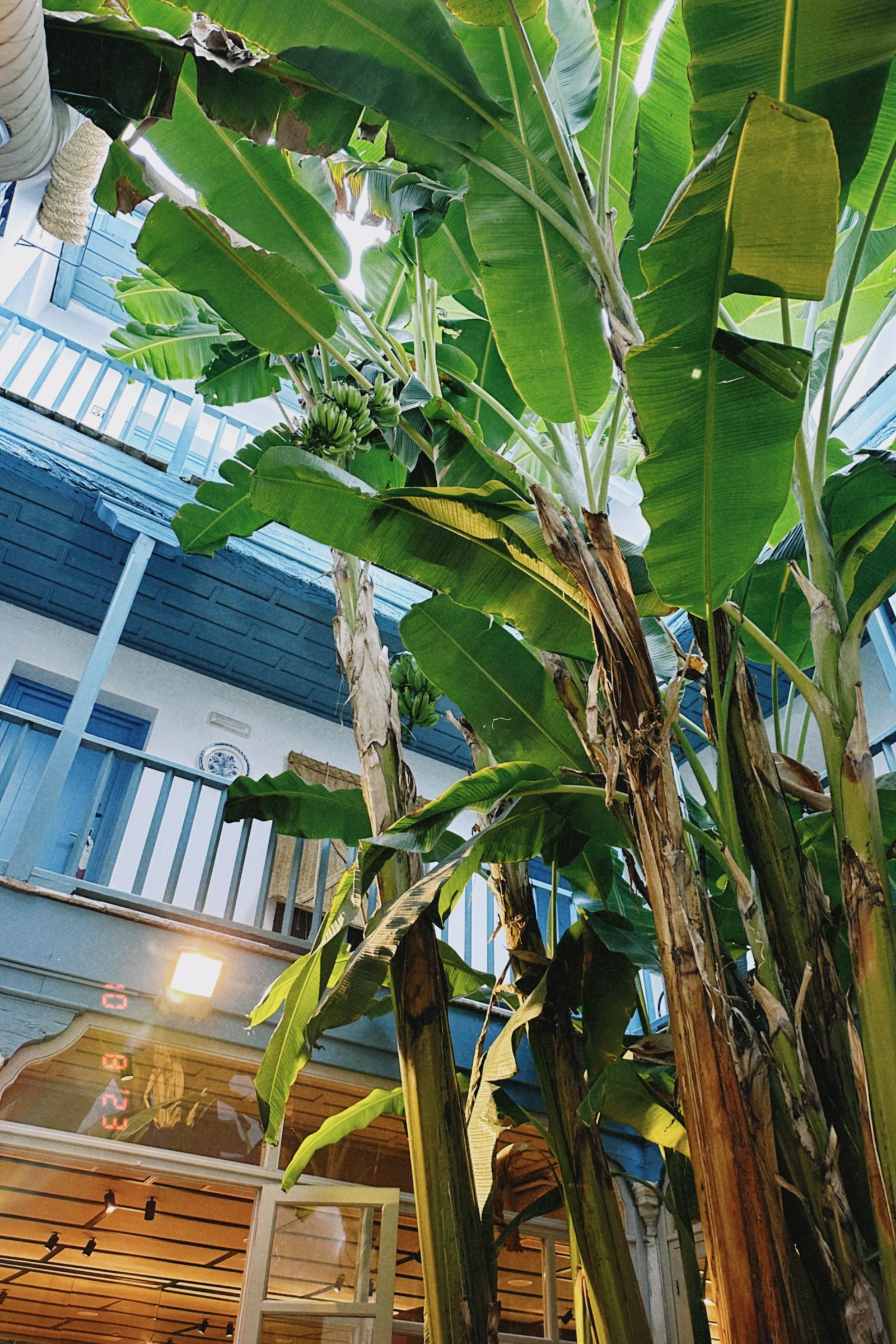
There is a library off one of the courtyards with a decent selection and somewhere to drink a glass of wine in the late afternoon, which is the correct use of it.
The rooms
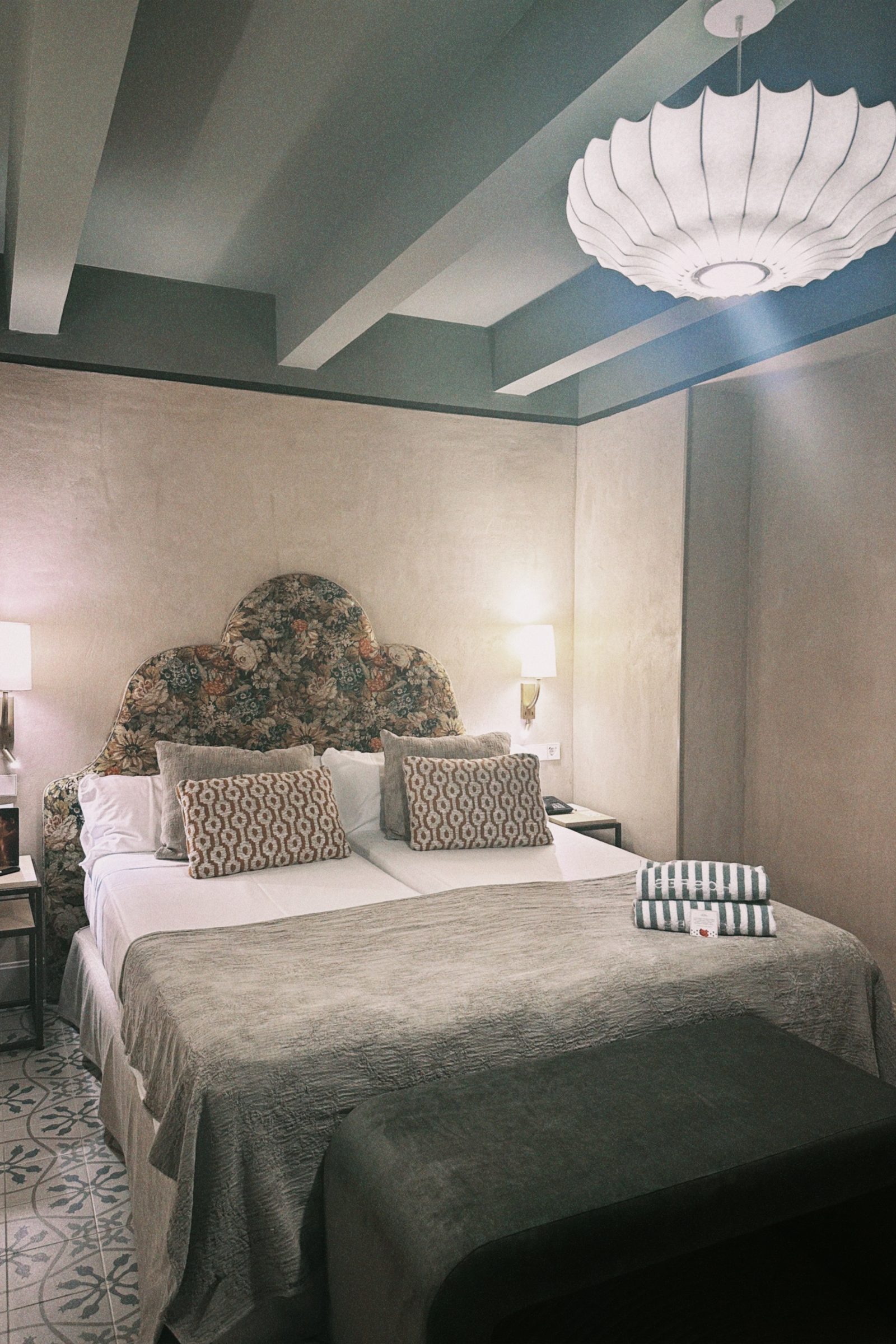
Larger than a converted eighteenth century building has any right to offer, and generous by Seville standards, where the old housing stock usually means a compromise. Painted timber beams across the ceiling, patterned cement floor tiles underfoot, a shell-shaped pendant, and headboards in a heavy floral that should not work against bare plaster walls and completely does. Shutters that actually shut, and proper blackout, which matters here from May onwards when the light arrives before seven.
Because it was forty one different dwellings rather than a purpose-built hotel, the rooms vary considerably. Ask for one on a courtyard rather than facing the street: they are quieter, cooler, and the view is the arcading rather than a wall.
The rooftop pool
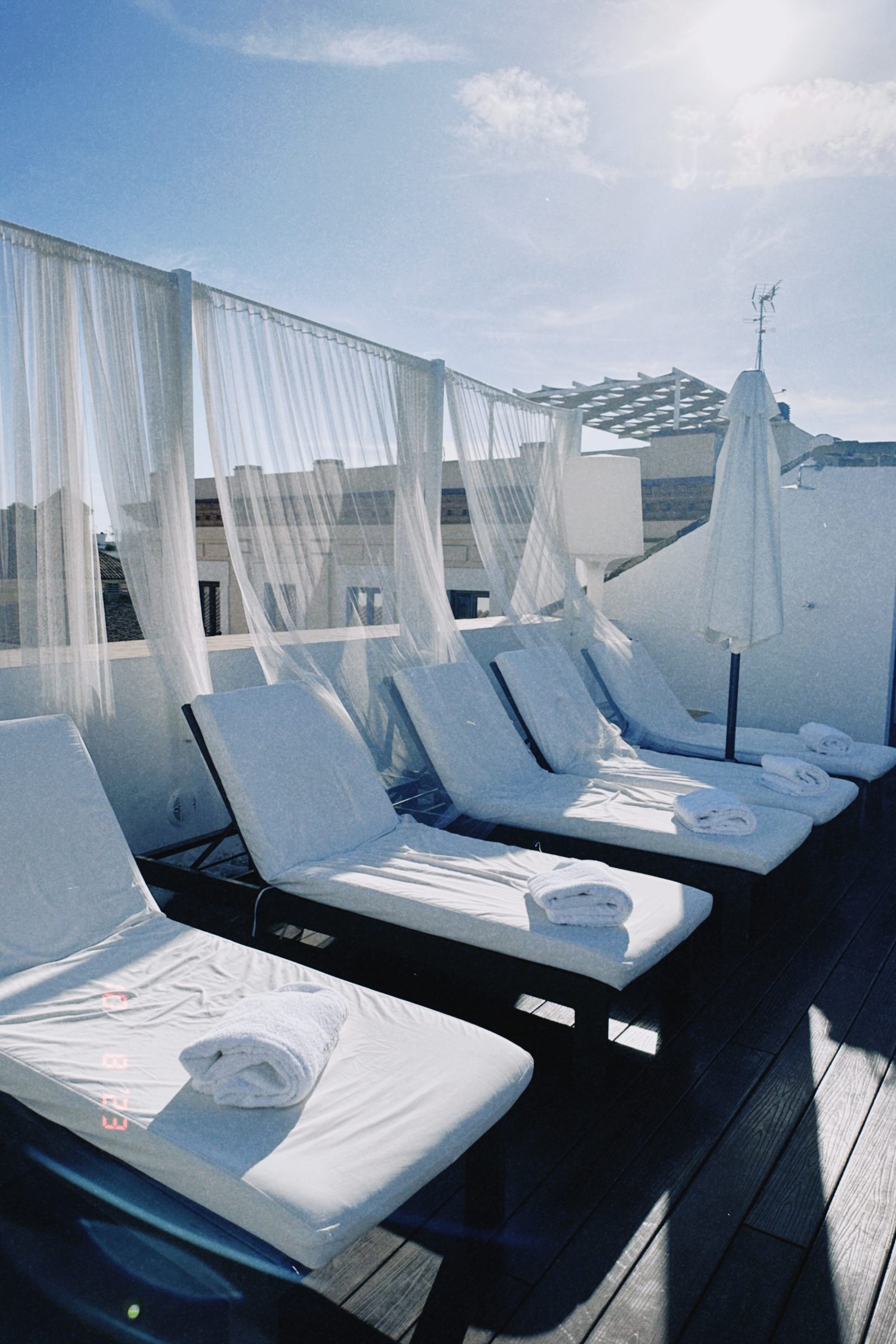
Small, and that is the point. A plunge pool on the roof with a row of loungers, white voile hung between posts to break the sun, a bar, and the Seville rooftops going off in every direction. It is not somewhere to swim lengths and nobody pretends otherwise.
What it is, is the single best amenity a Seville hotel can have. This city runs at forty degrees through July and August and the standard afternoon involves retreating indoors and waiting. Twenty minutes in cold water at four o'clock changes the shape of the day entirely, and it is why this hotel works in a season when others become a series of dashes between air conditioned rooms.
Worth knowing: it is unheated. In April or October it is bracing, which some people enjoy and others very much do not. From June to September it is perfect.
A plunge pool on a Seville roof in August is worth more than a spa in a city where you can walk anywhere in twenty minutes.
Service
The strongest thing about the stay, and the guest consensus agrees: warmth and attentiveness come up in review after review, and our experience matched it entirely. Small hotel, small team, and the sort of front desk that remembers what you asked yesterday without making a performance of it.
They are also genuinely good on the thing the location makes necessary. Ask for a taxi, ask for directions, ask them to write the address down in Spanish, and it is handled immediately.
Food
Breakfast is good and charged separately at around twenty five euros, which is worth building into the number rather than meeting at checkout. Taken in the courtyard early, before the heat, it is a pleasant hour.
Beyond that the hotel sensibly does not try to compete with its own neighbourhood. You are a short walk from the Alameda, which has the best casual eating in Seville, and any member of staff will point you at the right table. The district guide explains the difference between the areas here.
The number
Around a hundred and ninety five euros outside the spring peaks, which for a Design Hotels property in a protected eighteenth century building with a roof pool is straightforwardly good value. Seville prices are brutal during Semana Santa and the April Feria, when this and everywhere else doubles or worse and books out months ahead.
What you give up against the grander hotels is a restaurant worth staying in for and a spa. What you get is a building nobody else has, a pool that solves August, and a part of the old town that stays quiet. That is a trade most people would take twice.
The particulars
- Where: Santa Catalina, behind the church, in the old town's quiet north east corner.
- Ask for: a courtyard-facing room rather than the street.
- On arrival: take a taxi. Walk it afterwards, once you know the way.
- Do not miss: the roof at four in the afternoon, and the library at seven.
- Budget for: breakfast at about twenty five euros a head.
- Best months: May, June, September. Avoid Semana Santa and Feria unless that is why you are coming.
Read next

The paradores of Andalucia, and how to pick the ones worth the detour
Spain runs ninety-odd hotels in castles, monasteries and Renaissance palaces, at an average of about £112 a night. Five in Andalucia worth going out of your way for, including a UNESCO palace at €104 and a convent inside the Alhambra walls.
Anantara Villa Padierna: a Tuscan palace above Marbella, and the finest gardens on this coast
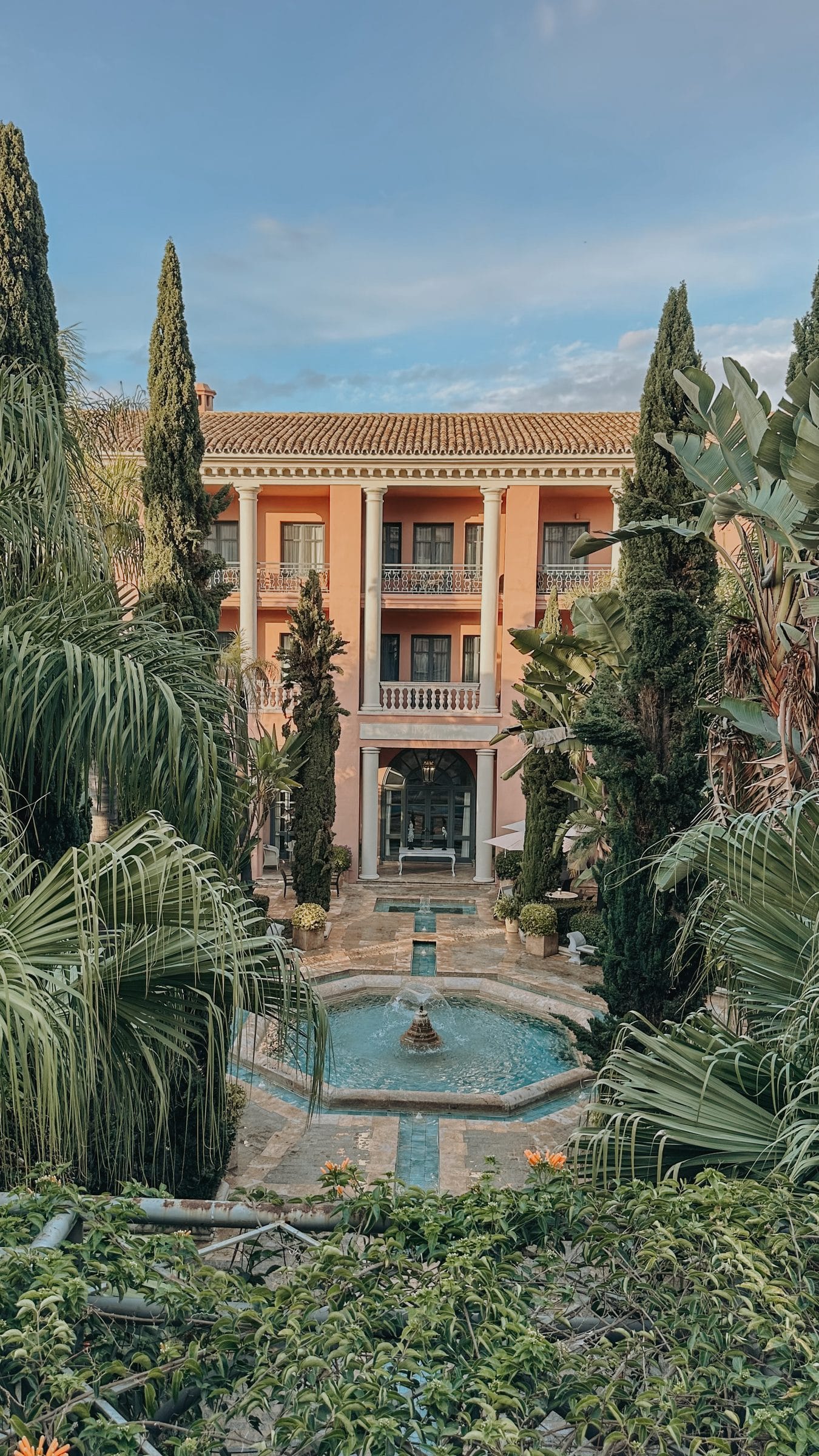
An Italianate palace ten minutes inland from Marbella, with formal gardens worth the trip on their own, a Roman pool, and staff who are the reason you would go back.
The best beach clubs in Marbella, and which day each one is for
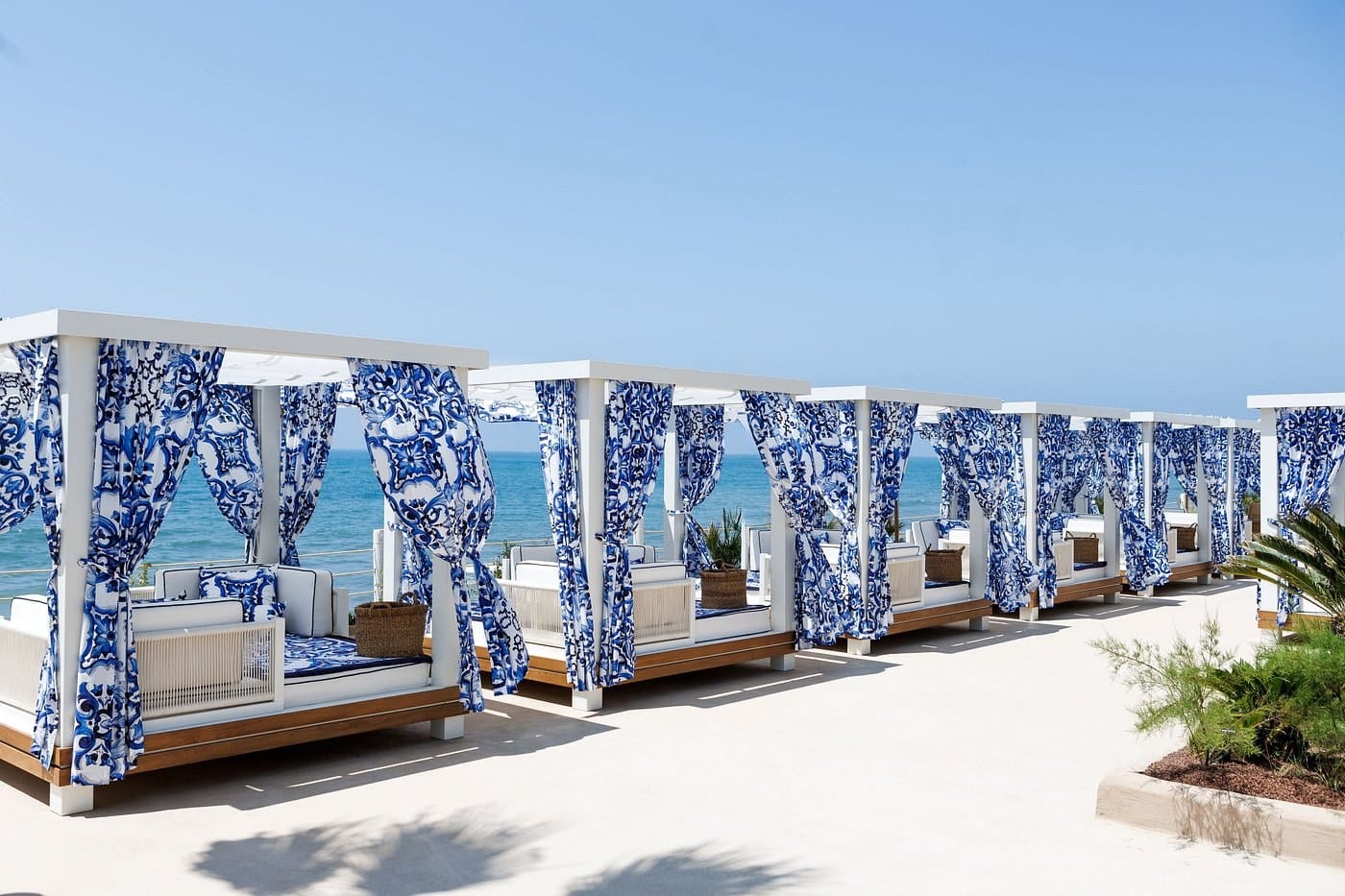
Five clubs on the same stretch of coast doing entirely different things: La Cabane, Nikki Beach, Puente Romano, Bono Beach, and La Plage Casanis, which Off-White has taken over for the season.