Against the itinerary, or why the best days away were the ones you did not plan
A weekend at home has to be planned, or the week will plan it for you. Away is the opposite. Everything you were trying to build arrives on its own, and the surest way to lose it is to fill the days up.

The half hour in the wrong direction, which is usually the good one.Annie Spratt / Unsplash
The itinerary gets written weeks before you go. A Tuesday evening, a kitchen table, eleven tabs open. It is a lovely thing to make. You check the opening hours. You measure the walking distances. The museum shuts on Mondays, so Monday becomes the coast.
Then you arrive. By the second afternoon you are running forty minutes late, and those forty minutes are doing the exact thing the holiday was meant to undo. You are looking at your phone to find out what you are supposed to be enjoying.
Who actually writes them
It helps to be honest about who makes these documents. Not quite you. The version of you who has not left yet: tired, at home, at the end of a long week, having spent real money and wanting something back for it.
It is written out of worry rather than appetite. Every line guards against one fear, and the fear is not boredom. It is waste. The feeling of having been somewhere beautiful and somehow missing it.
That is a fair thing to be afraid of. People do go to Granada and never see the Alhambra. But an itinerary answers the fear with volume, and volume is the wrong answer. It turns a week into a list, and a list is something you can fall behind on. You have carried the week's logic onto the plane with you.
The magic is never in the plan. It is in the hour you did not account for.
Deciding, not scheduling
We have made the case before for designing a Sunday at home. At home you have to. Left alone, a weekend fills up with admin and ends in front of a screen. Rest does not arrive on its own. You build it, or you do not get it.
Away is the opposite. Everything you were trying to manufacture is handed to you at the door. Nobody knows where you are. Nothing is piling up where you can see it. The pace has already changed by the time you find the light switch.
So the two ideas do not fight. Deciding is choosing the shape of a day: roughly where, roughly what. Scheduling is choosing its hours. At home, do both. Away, the second one is the very thing you paid to escape.
The morning with nothing in it
The first free morning in a new city feels wrong for about twenty minutes. There is a low hum of having forgotten something. That is just the week still running in the background, looking for the next item on a list that has ended.
Then it stops. What comes after is the thing people are really describing when they say they need to get away.
You walk out with no direction. Which way you turn is completely up to you, and it might be the first free decision you have made in a fortnight. Then the street hands you the next one.
What follows cannot be booked. A square you were not looking for. A bakery with a queue of people who obviously live there. An hour on a bench, doing nothing much. None of it would have survived a schedule, because none of it is worth writing down in advance. It is only worth having. This is the beautiful part of travelling, and it only happens in the gaps.
One thing a day
None of this means arriving with nothing. That has its own way of going wrong: three hours of everyone being agreeable about where to eat, and a disappointing lunch at the end of it.
One thing a day is the number that works. One booking. One anchor. One thing genuinely happening at a stated time. A table you want. A ticket with a slot on it. A drive it would be a shame to miss.
The rest of the day builds itself around that. A day with one fixed point has a shape. A day with six has a timetable.
Put the anchor in the afternoon and leave the morning open. If the thought of an open morning makes you uneasy, that is worth noticing. The unease is usually not about the holiday.
The half hour in the wrong direction
The best hour of most trips is spent walking away from the part of town you were told about. Not far. Half an hour will do. Pick your direction because the light looks better down there.
What you find is the ordinary version of the place, which is what people mean when they say somewhere felt real. The prices settle down. The menus stop being translated. You see what people do at five in the afternoon, and it is usually more interesting than the thing you would have queued for.
Wandering is not wasted time. It is the part you will still be describing in a year. It also loosens the rest of the trip: once you have been half an hour off the map and enjoyed it, the map stops feeling like an instruction.
What to book anyway
Some things punish improvising, and pretending otherwise would be silly. The list is short.
Anything with a timed entry and a queue. The Alhambra is the clearest example. Tickets sell out weeks ahead, the Nasrid Palaces let you in on a half hour slot, and turning up hopefully is not a plan. Book it, then put nothing else in that day.
The two or three tables you really want. Not every dinner. The places worth planning an evening around take bookings a fortnight out and fill them. Eating somewhere you chose, rather than somewhere that had space, is most of the difference between a good week and a fine one.
The first night, and how you get there. Where you sleep on night one, and the transfer if you land late. Arriving tired into an unsolved problem sets a tone that takes two days to shake off.
That is the whole list. Everything after it is a preference dressed up as a plan.
How to read a guide, including ours
We publish itineraries. Madrid in three days is exactly that, and it is genuinely useful, so it would be dishonest to spend a thousand words here pretending otherwise.
The difference is in how you use one. A good guide is a set of answers held in reserve until you need them: where to eat near where you happen to be standing, which of the two museums is yours, what a neighbourhood is like after dark. It stops being a reference and becomes a schedule the moment you decide to do all of it, in order, on the days given.
Read it properly before you go. Then put it away. What stays with you is the shape of the place and four or five things worth wanting, and that survives being late.
Where the magic actually is
At home, the conditions for rest do not exist and you have to make them on purpose, every week. Away, they are given to you at the door, and the only real way to lose them is to fill them.
So the two arguments are one argument, arriving from opposite ends. What you want, both times, is your own attention on your own life with nothing tugging at it. On a Sunday in your flat that takes planning. In a city you have never walked before it takes restraint.
Think about the days you still talk about years afterwards. They are almost never the ones that went to plan. They are the long lunch that ran into the evening. The wrong turning that turned out beautifully. The afternoon that was meant to be a museum and became a bench in the sun.
Nobody planned those. They were allowed to happen, which is a different thing, and mostly means leaving the room for them.
Read next

The paradores of Andalucia, and how to pick the ones worth the detour
Spain runs ninety-odd hotels in castles, monasteries and Renaissance palaces, at an average of about £112 a night. Five in Andalucia worth going out of your way for, including a UNESCO palace at €104 and a convent inside the Alhambra walls.

Are we tired of beige, or of rooms that could be anywhere
Colour is coming back to hotel interiors, and the trade press has decided this is a design story. It is closer to a complaint, made by guests, about rooms that could be anywhere.
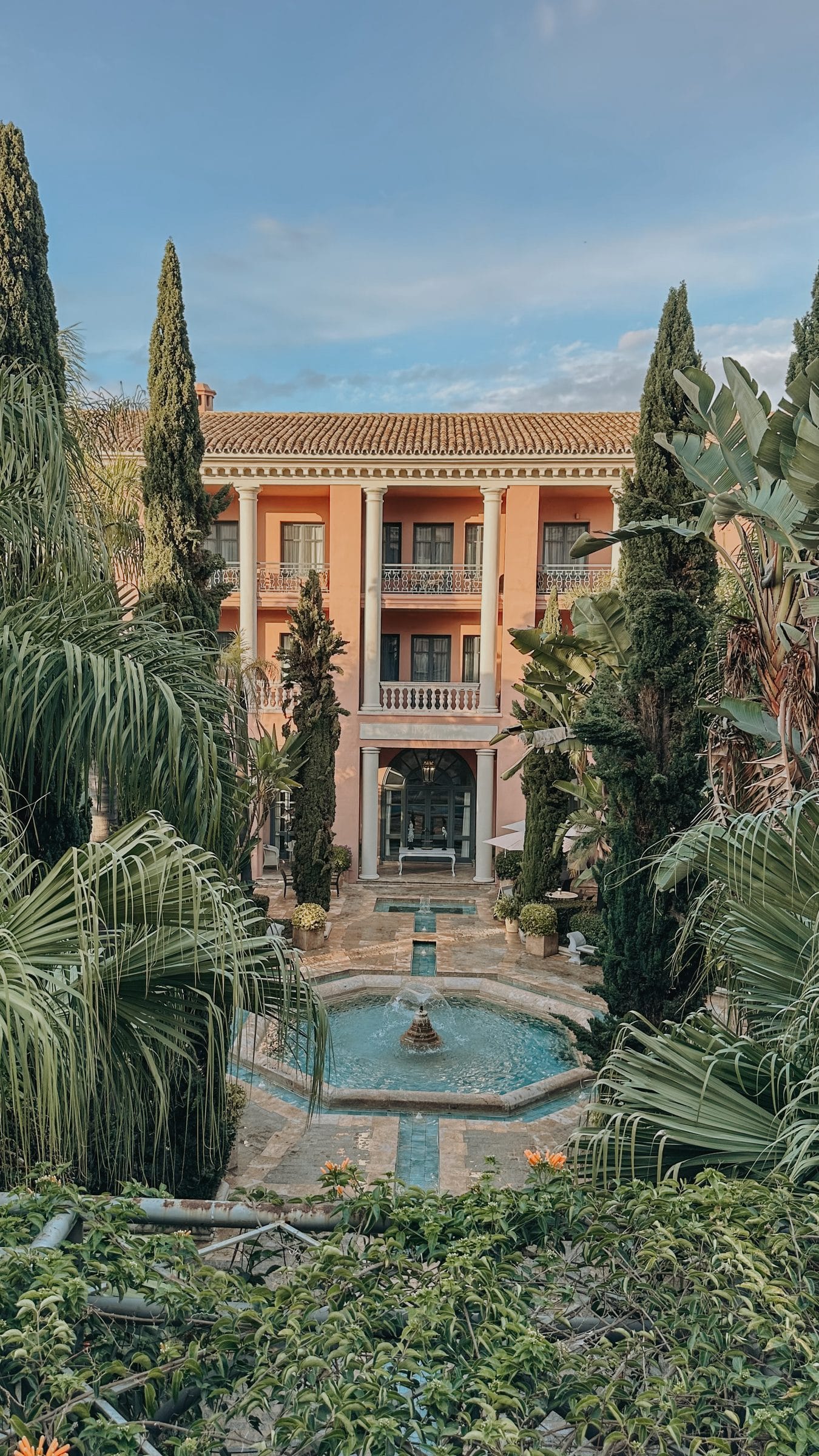
Anantara Villa Padierna: a Tuscan palace above Marbella, and the finest gardens on this coast
An Italianate palace ten minutes inland from Marbella, with formal gardens worth the trip on their own, a Roman pool, and staff who are the reason you would go back.