The best time to visit Andalucia, month by month
Seville in August is a punishment and Seville in February costs eighty euros a night. What each month is actually like, what it costs, the dates that move every year, and why Malaga in December is worth a trip on its own.

Zahara de la Sierra. April and October are when this walk is worth doing.Photograph Pedro Luis Domínguez Ruiz on Pexels · pexels.com
There is a version of this question that has a boring answer and a version that has a useful one. The boring answer is May and September, which is true, which everyone says, and which is why hotel rates in May and September have quietly caught up with June.
The useful answer is that Andalucia is eight regions pretending to be one, and the month that suits the Alhambra is not the month that suits Tarifa. Seville in August is a punishment. Seville in February costs eighty euros a night and smells of orange blossom by the end of it. The coast runs on a different calendar again, and the mountains on a third.
So: what each month is actually like, what it costs, and which of them are worth building a trip around.
The short answer
For the cities: late March to mid May, or late September to early November. For the beaches: June and September, with July and August if you can bear the company. For the lowest prices and an empty Alhambra: January and February, and bring a coat, because inland Andalucia in winter is colder than the brochures admit.
For something to actually happen while you are there: Semana Santa, the Cordoba patios in early May, or Malaga in December, which we will come to.
Month by month
January
The cheapest month of the year and the one most people write off without looking. Seville and Cordoba run to about sixteen degrees on a good afternoon, which is pleasant walking weather, and drop to three or four overnight, which is not. Andalucian buildings were designed to shed heat and they are extremely good at it, so a hotel with proper heating is worth paying for.
The Alhambra is the argument for January. Tickets are available at a week's notice rather than three months, the Generalife gardens are bare but the architecture is the point, and the Sierra Nevada sits behind it under snow. It is the best it looks all year. Our piece on the Alhambra goes into what to book and in what order.

The Cabalgata de Reyes on the evening of 5 January is the proper Spanish Christmas: three kings, floats, and roughly a tonne of boiled sweets thrown into the crowd at head height. Children love it. Wear a hat.
February
Almond blossom, which is the region's best-kept seasonal secret. The hills behind Granada, Almeria and the Axarquia go white and pink for about three weeks from late January, in a landscape that is otherwise brown, and almost nobody comes to see it. No tickets, no crowds, no infrastructure at all: you drive, and there it is.

The other February event is Carnaval de Cadiz, and it is not a small thing. Ten days of satirical singing groups, the chirigotas, competing in the Gran Teatro Falla and then spilling into the streets in costume. The lyrics are savage political comedy in a dialect that drops half its consonants, so you will understand roughly none of it and enjoy it anyway. It runs for about eleven days from the Thursday before Ash Wednesday, which puts it in early to mid February in 2027. Book accommodation in Cadiz absurdly far ahead, or stay in Jerez and take the train.
March
The month it turns. Days reach twenty degrees, the rain thins out, and around the middle of the month the orange trees in Seville flower. The smell of azahar in a Seville street in late March is the single best sensory experience in Andalucia and it lasts about a fortnight.
In 2027, Semana Santa falls in March: 21 to 28 March, with Easter Sunday on the 28th. That changes everything about a Seville trip, so see the section on moving dates below before you book anything.

April
Objectively excellent weather: twenty two to twenty five degrees, everything green before the summer burns it off, wildflowers through the Sierra de Grazalema. The best month of the year for walking the white villages, and the sea is still far too cold to bother with.
The complication is the Feria de Abril in Seville, two weeks after Holy Week, which in 2027 lands in mid April. A million people, a temporary city of striped tents on the far bank, flamenco dresses, sherry and a fairground. Most of the casetas are private and you need an invitation, which the guides tend not to mention. Go for the horses and the atmosphere in the streets, not because you expect to be let in anywhere.
May
If you made us pick one month, this. Twenty five to twenty eight degrees, jacaranda out in Seville, everything open and nothing yet unbearable.
It is also the Festival de los Patios in Cordoba, roughly the first two weeks of May, and it is the most charming thing in the Andalucian calendar. Around sixty private courtyards open free to the public, twice a day, and residents compete to have the best one. Whitewash, blue paint, and every vertical surface covered in geraniums in tin pots.

Go in the morning session, from about eleven, rather than the evening one. The queues in the San Basilio district by six in the evening are genuinely long, and the light is better earlier anyway.
June
The last comfortable month inland and the first good one on the coast. Low thirties in Seville, which is hot but survivable, and the Mediterranean has finally warmed up to something you would willingly get into. Spanish school holidays have not started, so the beaches are still yours.
The night of 23 June is San Juan: bonfires on the beach, people jumping over them or walking backwards into the sea depending on which superstition they favour. Every beach town on both coasts does it and it goes on until dawn.
July
Now it is serious. Seville and Cordoba run at thirty eight to forty degrees, and Cordoba holds the record for the hottest temperature ever recorded in Europe. The cities do not stop, they simply move: shutters closed until six, streets hung with toldos, awnings strung between the buildings to throw the whole street into shade, and dinner at ten.

Our honest position: do not build a first trip to Seville around July. Go to the coast instead, where the sea and the wind take ten degrees off, and treat the cities as day trips with a hard finish by noon.
August
The hottest month, the busiest coast, and the emptiest cities, because Spain itself is on holiday. Whole streets of good restaurants in Seville close for the month, and the ones that stay open are the ones aimed at people who did not know that.
The coast is a different proposition: the Costa de la Luz has the wind, which is why Tarifa exists and why it is bearable in August when Marbella is not. The Feria de Malaga in mid August is the biggest summer fair in the region, nine days, and it takes over the whole city centre from noon.
If you are coming in August, book a hotel with a pool. Not a nice-to-have. The one Seville hotel we would stay in through the summer has a plunge pool on the roof and that is most of the reason.
September
The quiet winner, and the month we would book if the flights cooperated. The heat breaks in the first fortnight, the sea is at its warmest of the entire year at around twenty three degrees on the Mediterranean, and the school holidays end, which empties the beaches without cooling them.
Early September is also the vendimia, the grape harvest, and Jerez marks it with a fortnight of festival. Sherry is a genuinely undervalued reason to visit this corner of Spain, and the bodegas are at their most interesting in the weeks the grapes come in.
October
Twenty five degrees, cheap, and still swimmable in the Mediterranean for the first three weeks. The best value fortnight in the Andalucian year is probably the first half of October: May weather at February prices, with the caveat that the rain returns towards the end of the month and can arrive as a proper Atlantic front rather than a shower.
Good month for the cities. If you are choosing between Seville and Granada, October suits both, which is not true of July.
November
The wettest month, and priced accordingly. Days are mild, around eighteen or nineteen degrees, but you will lose one in three to rain and the light goes by six.
Two things make it worth considering. The olive harvest starts in Jaen, which has more olive trees than anywhere else on earth, and the new oil that comes out of it in late November and December is a completely different substance from the bottle in your kitchen: green, peppery, and best eaten on bread while standing up. And the Christmas lights go on at the end of the month, which brings us to the reason a lot of people should be looking at December.
December
Bright, cold-ish, cheap until the week before Christmas, and far better than its reputation. Seville and Cadiz sit in the mid to high teens through the day, which is short-sleeve weather to a British visitor and a heavy coat to a Sevillano. The cities fill with belenes, the elaborate model nativity scenes that Spanish towns compete over, and every square gets a market.
And then there is Malaga.
The Malaga Christmas lights, which deserve their own section

Every Spanish city puts up lights. Malaga does something else, and it has quietly become one of the largest free public events in Europe.
Calle Larios, the wide marble-paved shopping street running up from the port, is roofed for six weeks in an illuminated structure that is designed as architecture rather than decoration. Around 2.7 million LEDs go into the historic centre, and the Larios installation is built on tall columns holding an arched canopy the length of the street, so you are not looking at lights on a street: you are standing inside a nave.
Then, several times a night, they run it as a show. The whole street is choreographed to music, usually with a choir, and the sequence takes about ten minutes. Recent years have run three shows a night, at roughly half past six, half past eight and ten, every night from the switch-on until the first days of January, with the shows paused on Christmas Eve and New Year's Eve.
The switch-on is the last week of November and is itself an event, with the street closed and packed. It is all free.
It is the only Christmas lights display we would plan a trip around, and the only one that has ever made a street full of strangers go quiet.
Practical notes, because the crowds are real. Get onto Larios twenty minutes before a show or you will watch it from behind three rows of raised phones. The ten o'clock show is the least busy by a wide margin. Weekends in the fortnight before Christmas are close to impassable, and a Tuesday in early December is a completely different and much better experience. Combine it with the Muelle Uno lights along the waterfront and the market in the Plaza de la Constitucion, and note that the Christmas installation on Calle Larios is a separate thing from the city's ordinary summer awnings on the same street, which confuses more people than you would think.
Malaga in December also gives you an underrated city with nobody in it: the Picasso museum, the Alcazaba and the rest are all quiet, the airport is the best connected in the region, and hotel rates outside the Christmas week are among the lowest of the year.
The dates that move every year
Four things in the Andalucian calendar are tied to Easter rather than the diary, and if you book blind you will either walk into them or narrowly miss them. Both are worse than deciding on purpose.
- Carnaval de Cadiz: eleven days from the Thursday before Ash Wednesday. Early to mid February in 2027.
- Semana Santa: Palm Sunday to Easter Sunday. In 2027 that is 21 to 28 March. Seville, Malaga and Granada all do it seriously and the city centres become impassable for a week.
- Feria de Abril, Seville: two weeks after Easter, so mid April in 2027. Rates triple and book out by January.
- Festival de los Patios, Cordoba: fixed to early May rather than Easter, usually the first two weeks.
On Semana Santa specifically: it is extraordinary and it is not a sightseeing week. Processions close streets without warning, taxis stop working in the centre, and getting from one side of Seville to the other can take two hours. Come for it deliberately, stay somewhere you can walk from, and abandon any plan involving a fixed appointment. Which district you pick matters more that week than any other.
What it costs, by season
Rough guide to a decent four star double in Seville, which tracks the whole region reasonably well:
- January, February, November: eighty to a hundred and twenty euros. The genuine low season.
- March, June, October: a hundred and forty to a hundred and eighty. Good weather, sane prices, our preferred compromise.
- April, May, September: a hundred and eighty to two hundred and fifty. The peak that nobody calls a peak.
- Semana Santa and Feria: three to five times the normal rate, with minimum stays attached. This is not a typo.
- July and August, inland: often cheaper than May, for the obvious reason. On the coast, the opposite.
The coast inverts the whole table. Cadiz province in August is the most expensive fortnight of its year and half empty by the end of September.
So when should you go
If it is your first trip and you want the cities: the second half of April, or the first half of October. Warm, open, and you will get into the Alhambra.
If you want the beach: September, without much argument.
If you want it cheap and you do not mind a coat in the evenings: February, for the blossom and an Alhambra you can move around in.
And if you want one thing you will still be describing in March: Malaga, early December, on a weekday, twenty minutes before the ten o'clock show.
Read next

The paradores of Andalucia, and how to pick the ones worth the detour
Spain runs ninety-odd hotels in castles, monasteries and Renaissance palaces, at an average of about £112 a night. Five in Andalucia worth going out of your way for, including a UNESCO palace at €104 and a convent inside the Alhambra walls.
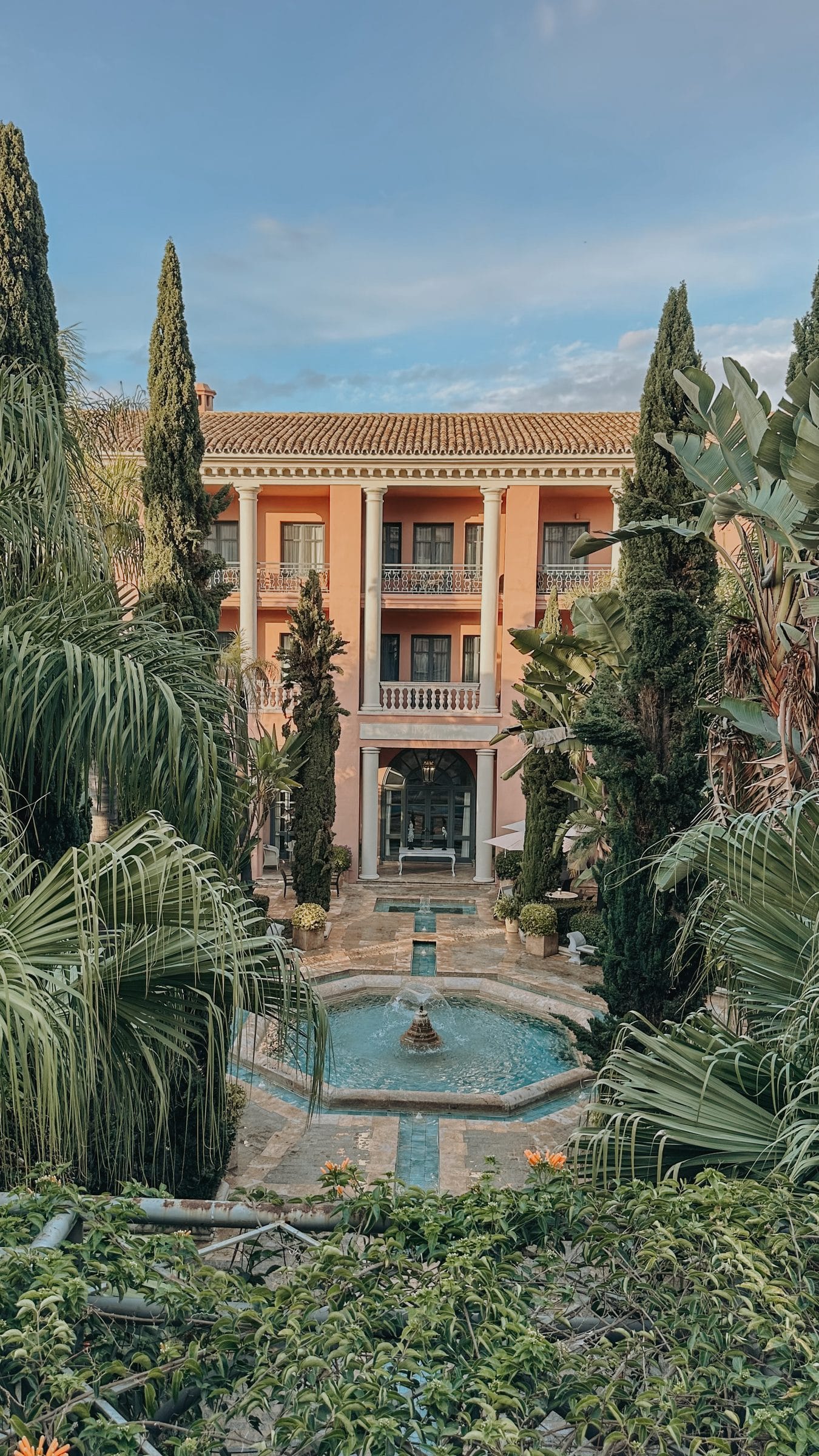
Anantara Villa Padierna: a Tuscan palace above Marbella, and the finest gardens on this coast
An Italianate palace ten minutes inland from Marbella, with formal gardens worth the trip on their own, a Roman pool, and staff who are the reason you would go back.
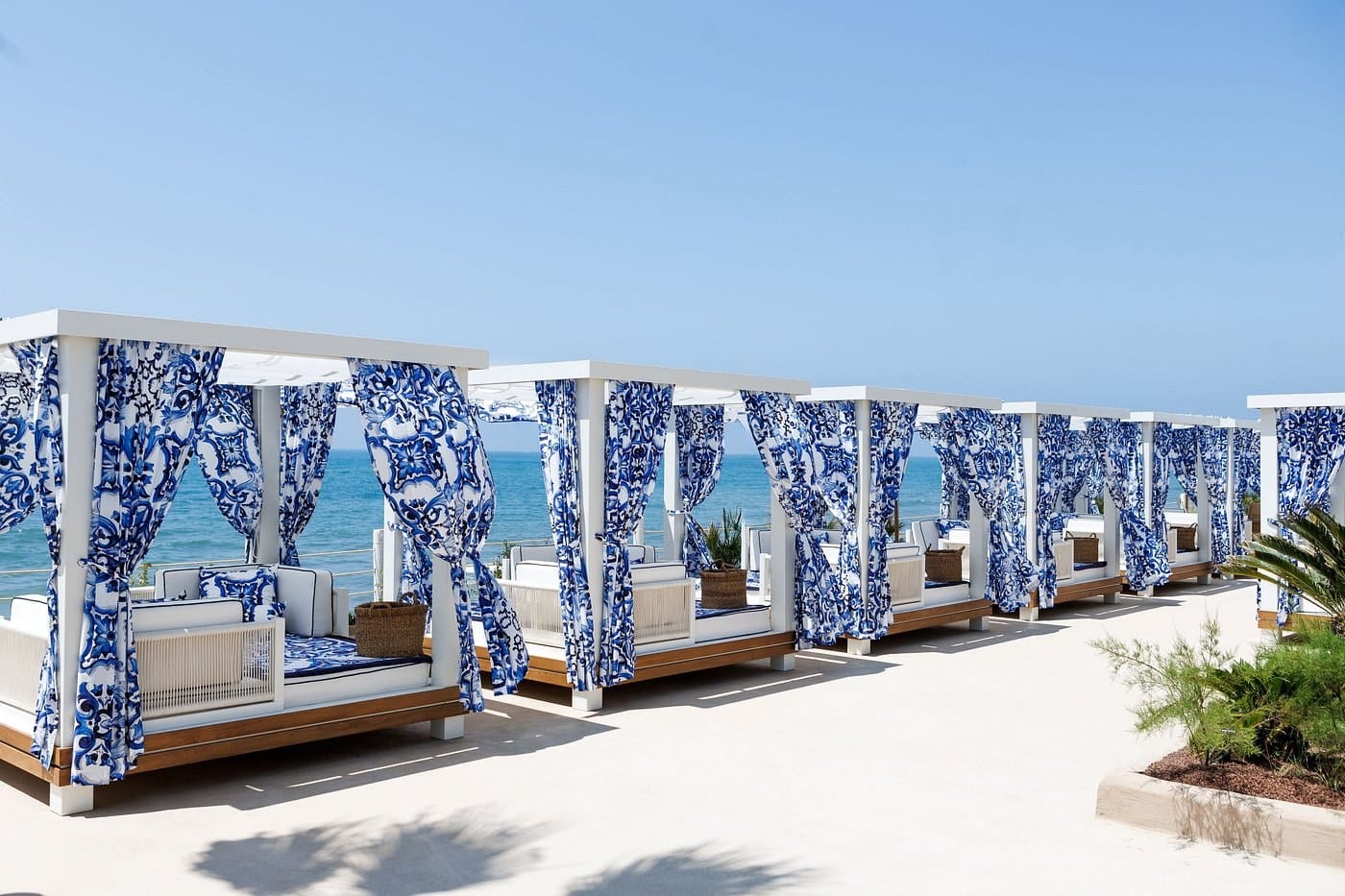
The best beach clubs in Marbella, and which day each one is for
Five clubs on the same stretch of coast doing entirely different things: La Cabane, Nikki Beach, Puente Romano, Bono Beach, and La Plage Casanis, which Off-White has taken over for the season.